MZ / ELECTRICAL ENGINEERING

GEORGIA TECH · ATLANTA, GA

Michael ZhaoCurrent Electrical Engineering
Student at Georgia Tech

Exploring the connection between energy, intelligent machines, and the systems that make them work.

I am an Electrical Engineering student at Georgia Tech with a background in applied mathematics, statistics, and economics at Emory University. I bring an analytical approach to hands-on engineering, with interests in power systems, automation, and robotics. This portfolio shares the work, experiences, and next steps shaping my development as an engineer.

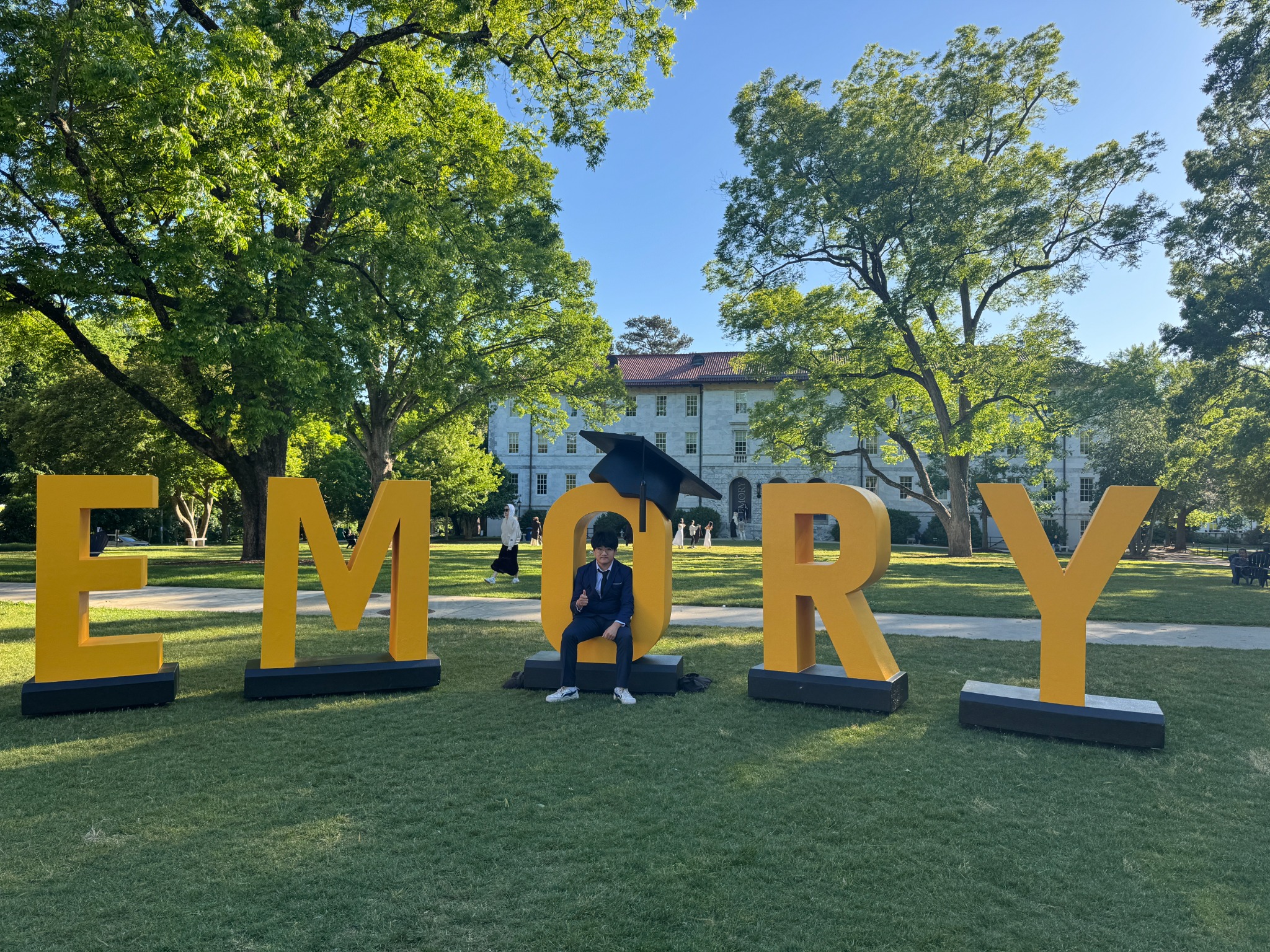
Michael Zhao seated at the Emory letters on campus
MICHAEL ZHAOEmory roots. Georgia Tech engineering.
EMORY → GEORGIA TECHMATHEMATICS + HARDWARE + CURIOSITYEXPECTED GRADUATION · MAY 2028

A mathematical foundation.
A practical direction.

My path into electrical engineering began with an interest in understanding how things work. Robotics made that interest tangible: a machine has to sense its environment, make decisions, and turn those decisions into physical motion. I wanted to understand the electrical and computational systems behind that process, and to learn how to build and test them myself.

At Emory University, I studied applied mathematics and statistics alongside economics. That background taught me to work with models, examine assumptions, and use data to support a conclusion. It also showed me that a useful analysis must answer a clear question. I now bring that way of thinking to Georgia Tech through the Emory–Georgia Tech dual-degree program, with an expected graduation in May 2028.

My work in data analysis helped me appreciate the importance of communicating technical information. During my internship at NextTier, I worked with customer data, A/B testing, and Tableau dashboards. My earlier accounting internship at PwC involved organizing financial information and supporting reports. Although those settings differ from an engineering lab, both required careful attention to evidence and clear explanations.

At Georgia Tech, I am developing the hardware side of that foundation through circuit analysis, signal processing, and RoboJackets. On the RoboWrestling electrical team, I contribute to firmware and PCB design for a 500 g autonomous sumo robot. I am still building experience, and I value projects that make me connect an equation, a piece of code, and the behavior of a real system.

01

Understand the model

Identify assumptions and use mathematics to reason about a system.

02

Build with purpose

Connect hardware and software choices to a clear engineering task.

03

Learn from evidence

Compare expected and observed behavior, then refine the approach.

Learning through
systems and signals.

Team contributions and coursework.
Each project is a step toward deeper engineering judgment.

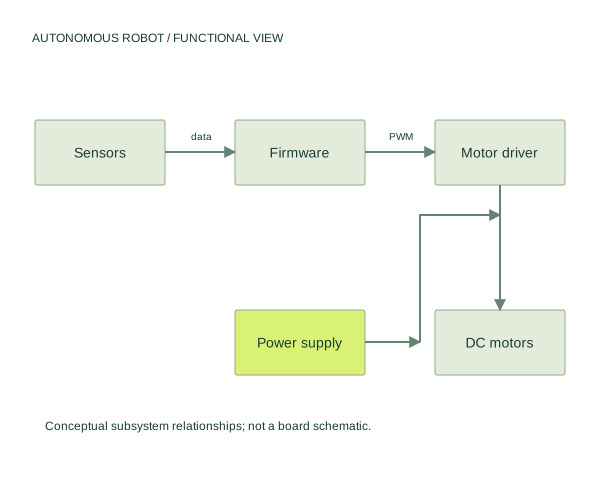
Conceptual robot architecture showing sensors, firmware, motor driver, motors, and power supply
Conceptual architecture · not a photograph of the team robot
01 / ROBOTICS ONGOING TEAM PROJECT

RoboWrestling
500 g sumo robot

C++ · KiCad · Firmware · PCB design

The problem. An autonomous sumo robot brings multiple electrical subsystems together in a compact platform. Sensing, decision logic, motor control, and power delivery all need to support the same behavior. This makes the project a useful setting for learning how individual design choices affect a complete machine.

My contribution. Since September 2026, I have participated on the RoboWrestling electrical team, contributing to C++ firmware and PCB design in KiCad. My work includes involvement in component selection, schematic capture, board layout, and routing. I describe this as a team contribution because the robot depends on work across multiple people and disciplines.

What I am developing. I am learning to connect software behavior with hardware constraints and to explain design decisions clearly to teammates. My next milestone is to document one bounded contribution with its requirements, a test procedure, observed behavior, and revisions. The project is ongoing; competition results and completed performance measurements are not reported here.
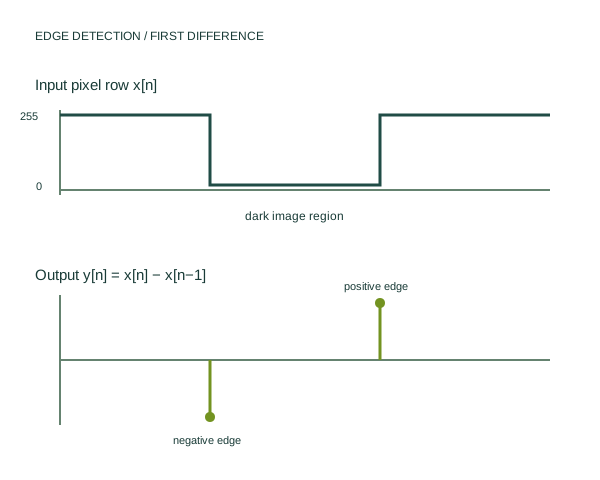
Illustrative one-dimensional edge detection: a black region produces negative and positive impulses after a first-difference filter
Illustrative signal · first-difference filter, h[n] = [1, −1]
02 / SIGNAL PROCESSING COURSEWORK

Finding image edges
with a simple filter

MATLAB · Convolution · Discrete-time signals

The question. How can a short digital filter reveal a boundary in an image? In my signal-processing coursework, I examined a row of a black-and-white image as a sequence of pixel values. This connected the visual idea of an edge with a mathematical change in a discrete-time signal.

The process. I used a first-difference filter to compare adjacent samples. A uniform region produces zero response, while a transition produces a positive or negative impulse depending on the direction of the brightness change. Taking the absolute value makes either direction detectable with a threshold. I also examined how convolution changes sequence length and how boundary samples affect the interpretation.

The learning outcome. This exercise helped me connect MATLAB output with the underlying operation instead of treating a plot as a final answer. It reinforced the need to state indexing conventions and distinguish an image boundary from a boundary introduced by zero extension. The illustration shows the filtering principle; it is not presented as an original image from the assignment.

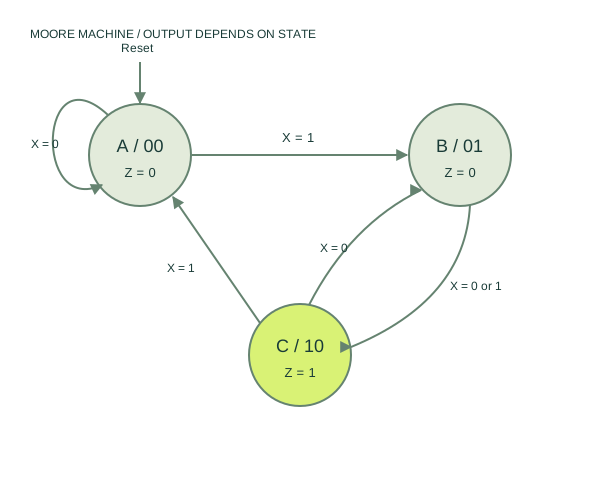
Moore state machine: A loops on zero and goes to B on one; B goes to C for either input; C goes to B on zero and A on one
Coursework model · transitions occur on the active clock edge
03 / DIGITAL LOGIC COURSEWORK

From a state diagram
to sequential logic

Moore machine · D flip-flops · Verification

The problem. A sequential circuit must remember its current state and update it consistently when an input changes and a clock edge arrives. My digital-logic lab work used a three-state Moore machine to connect state diagrams, transition tables, and circuit behavior.

The process. The states are A = 00, B = 01, and C = 10, with the output high only in C. From A, input 0 holds the state and input 1 moves to B. B moves to C for either input. From C, input 0 returns to B and input 1 returns to A. Reset returns the machine to A. I worked through how these transitions determine the next-state inputs for D flip-flops.

The learning outcome. The key lesson was to verify each transition from a known starting state. A demonstration needs to show the present state, input, clock action, next state, and output clearly. This approach makes a mismatch easier to trace to a table entry, wiring issue, or timing assumption, and gives me a more systematic way to approach future digital designs.

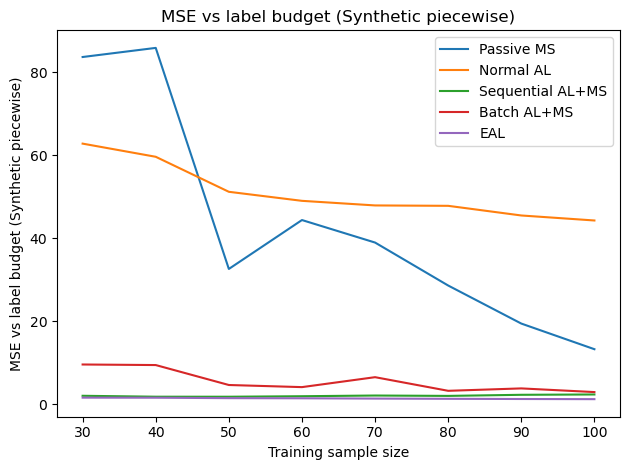
Figure from my Math 385 report comparing test MSE with label budget on a synthetic piecewise dataset
From my Math 385 report · synthetic dataset comparison
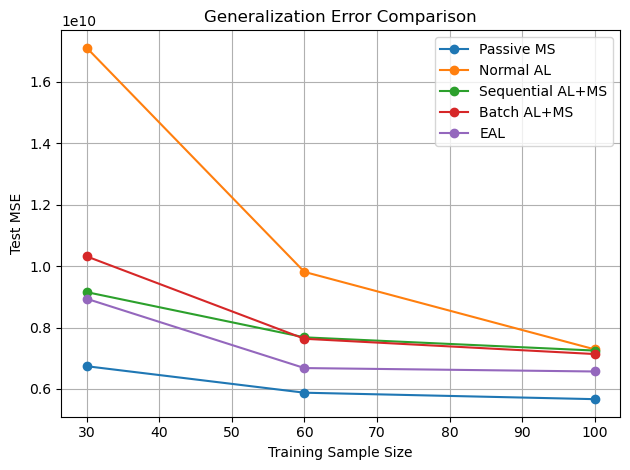
See the California housing comparison +California housing results from my report, where passive model selection performs best
04 / MACHINE LEARNING MATH 385 FINAL PROJECT

Active learning
with model selection

Python · Ridge regression · Cross-validation · ALMS

The problem. Active learning chooses which data points to label, but those choices depend on a model. Selecting that model also requires labeled data. My Math 385 final project investigated this dependency and asked when combining several candidate models could use a limited labeling budget more effectively.

My approach. I implemented five strategies: passive model selection, fixed-model active learning, sequential active learning with model selection, batch active learning with model selection, and ensemble active learning (EAL). I compared them using polynomial features and ridge regression, varying polynomial degree and regularization strength through cross-validation. Experiments used California housing data and a synthetic piecewise dataset with distribution shift that I generated.

The results. On the synthetic dataset, EAL achieved a reported final test MSE of 1.243 at a label budget of 100, compared with 13.272 for passive model selection. On California housing, however, passive model selection performed best. These are results from my project experiments, rather than evidence that one strategy always wins.

What I learned. A method's value depends on the data and the uncertainty in early model choices. I also identified the limited polynomial-and-ridge model family as a constraint, with richer nonlinear models as a possible extension.

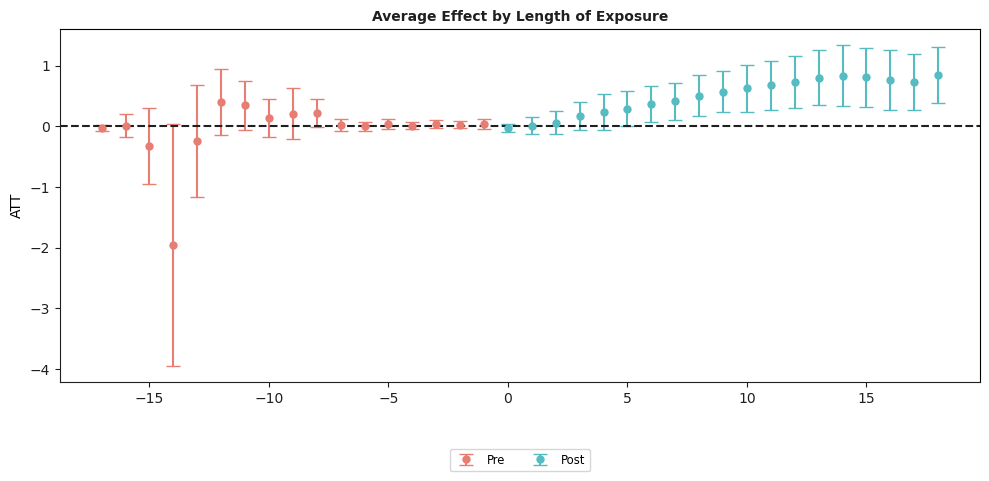
Event-study figure from my economics paper showing estimated unemployment effects before and after early benefit termination
From my economics paper · dynamic effects with confidence intervals
05 / ECONOMIC RESEARCH EMPIRICAL PROJECT

Unemployment benefits
and labor-market recovery

Panel data · Difference-in-differences · Policy evaluation

The question. Did ending federal pandemic unemployment benefits early reduce state-level unemployment? My paper examined the policy differences across U.S. states in 2021, comparing states that ended participation in June or July with states that continued until the nationwide expiration in September.

My approach. I assembled monthly unemployment data for 50 states from January 2020 through December 2022, using BLS data accessed through FRED. The analysis applied the Callaway and Sant’Anna multi-period difference-in-differences framework to estimate group-time treatment effects and aggregate them by cohort and event time. This allowed me to examine differences in policy timing instead of relying on a simple comparison of unemployment levels.

The findings. The paper reports an aggregate estimate of approximately +0.495 percentage points, with a 95% confidence interval of 0.194 to 0.796. In this analysis, early termination was associated with higher unemployment relative to comparison states; the positive pattern was mainly driven by the June cohort. The July cohort's estimates were less precise.

What I learned. Results need to be interpreted alongside their assumptions and limitations. Noisy pre-treatment estimates, cohort differences, and the end of federal benefits for comparison states in September limit how broadly I can interpret later estimates. The project strengthened my ability to organize panel data, explain an identification strategy, and communicate uncertainty.

HARDWARE DESIGN

Inside the PCB design process.

A dedicated space for schematics, board layouts, and 3D views.

Visit my KiCad page ›

Build strong fundamentals.
Work on systems that matter.

My long-term goal is to help make electrical systems more efficient and reliable. I am particularly interested in power electronics, automation, and the electrical infrastructure supporting data centers. I also want to explore how control and embedded hardware connect these areas to robotics.

Career plan: strengthen fundamentals in 2026–27, seek industry experience in summer 2027, deepen expertise in 2027–28, and enter engineering or graduate research after graduation

My next steps at Georgia Tech

First, I plan to strengthen my understanding of circuits, signals, programming, and measurement. Electric Energy Systems and Robotics and Autonomous Systems are thread interests in my professional development plan, with Circuit Technology as another option. I will use advising and project experience to decide which combination best supports my goals.

Alongside coursework, I want to take ownership of a clearly defined RoboWrestling task and document it carefully. A useful portfolio entry should explain what I contributed, how I tested it, and what changed after testing. I also plan to explore undergraduate research in power electronics or control to experience a more open-ended engineering question.

From student to practicing engineer

I am seeking engineering internship opportunities for Summer 2027 in power, energy, electronics testing, or embedded hardware. My goal is to see how engineers manage requirements, safety, deadlines, and design tradeoffs in practice. Before May 2028, I want to combine that experience with a stronger technical portfolio and clearer communication skills.

After graduation, I am considering an engineering role or graduate research. I want internship and research experience to help guide that decision. Within five years, I hope to be contributing to practical electrical designs or focused research; over the longer term, I would like to lead technical projects and mentor engineers who are beginning their own careers.

Analytical experience.
Engineering momentum.

Choose a resume version ↓

Experience

JUN – AUG 2025

NextTier

Data Analyst Intern · Customer segmentation, A/B testing, and Tableau reporting.

MAY – JUN 2024

PricewaterhouseCoopers

Accounting Analyst Intern · Audit reporting, financial data organization, and due diligence support.

SEP 2025 – MAY 2026

Emory University

Student IT Assistant · Equipment setup, software installation, troubleshooting, and support documentation.

Technical toolkit

I use Python, C, and C++ for programming, MATLAB for analytical coursework, KiCad for PCB design, and Tableau for communicating data. My hardware learning includes timers, PWM, and DC motor control. I am continuing to develop these skills through coursework and practical projects.

PythonC / C++MATLABKiCadTableauKeil µVision

Education

Emory–Georgia Tech dual-degree program
Electrical Engineering · Applied Mathematics & Statistics · Economics
Expected graduation: May 2028

05 / LET’S CONNECT

Good engineering
starts with curiosity.

I welcome conversations about electrical engineering internships, undergraduate research, and robotics projects.

zhaojinghao79@gmail.com ›
PHONE781-530-6950
ADDRESS
880 W Peachtree St NW
Atlanta, GA